
Project illustration; identifying client material is withheld.
A repeatable image-enhancement workflow for a large automotive catalogue
Catalogue image-enhancement workflow
An automotive-parts business had a catalogue containing more than 60,000 product images. The source material varied in resolution, crop, lighting, background, and overall presentation, leaving the catalogue visually inconsistent.
A complete photography reshoot would have been slow, expensive, and disruptive. I built an AI-assisted image-enhancement workflow that could improve the existing library at scale and continue processing new imagery as the catalogue changed.
A system, not a retouching exercise
Correcting a handful of images manually would have been straightforward. The real problem was applying a consistent treatment across tens of thousands of source files whose starting quality and proportions differed substantially.
As the sole developer, I designed and implemented the complete processing pipeline. It combined generative image-editing techniques with repeatable automation to improve clarity, resolution, colour, composition, and presentation across the catalogue.
The work had to be useful as a production process, not merely capable of producing an impressive individual example. Source variation, failed outputs, processing volume, and consistent delivery all had to be treated as parts of the product.
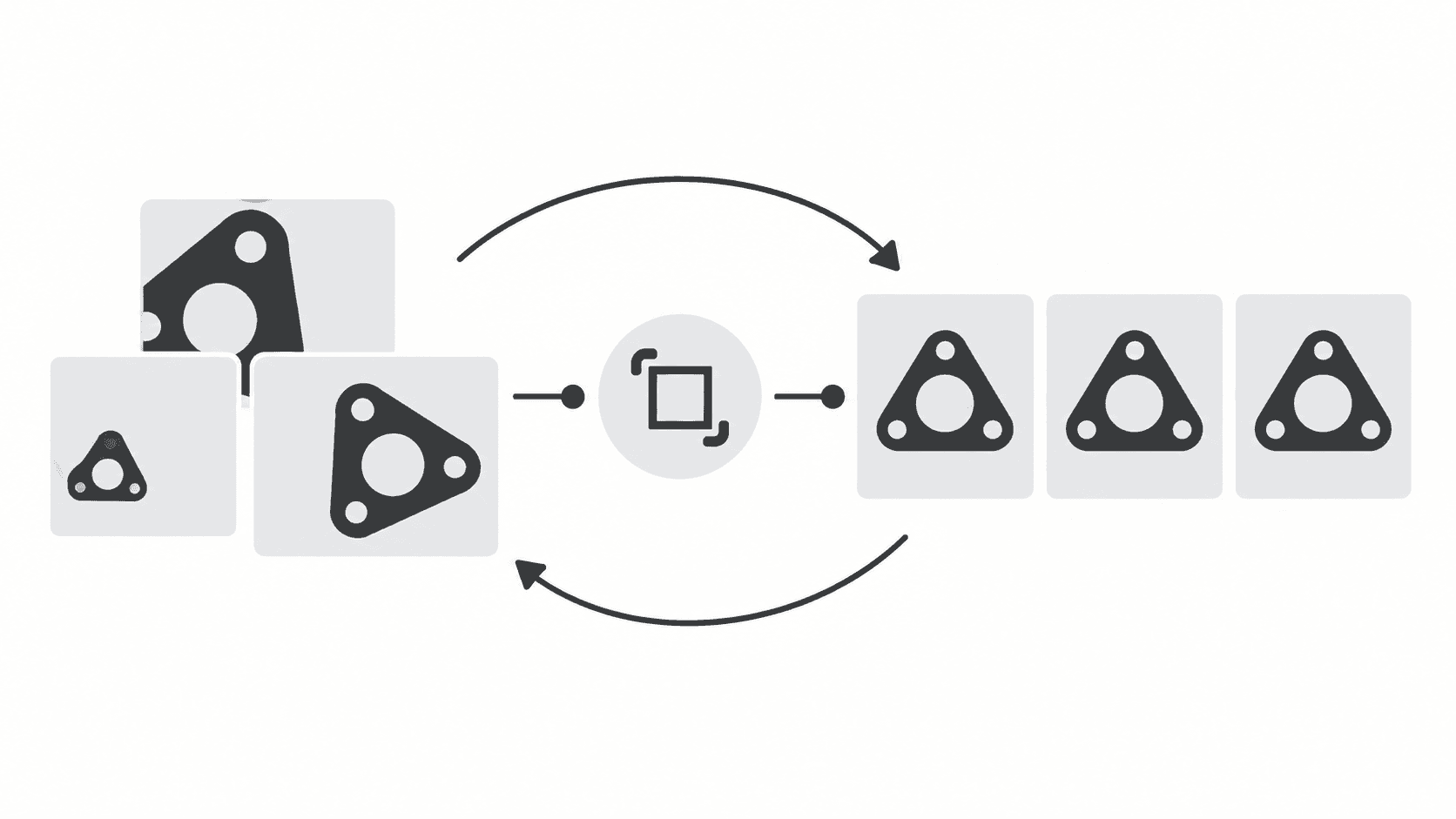
Variable source images passed through one repeatable process so catalogue assets received a consistent treatment.
Making the workflow repeatable
The initial catalogue could be handled as a high-volume batch, reducing the manual effort that would otherwise have been needed to correct every asset individually.
I also exposed the capability through an API so that new product images could enter the same workflow later. That turned the project from a one-off clean-up into an ongoing catalogue operation that could be connected to the client’s existing systems.
The outcome
More than 60,000 automotive product images were enhanced without requiring a full reshoot. The finished system provided a more consistent catalogue presentation and a reusable way to treat new imagery as products were added or updated.
The important result was not AI imagery by itself. It was pairing image generation and correction with the engineering needed to make the process repeatable at catalogue scale.
The client name, original source images, generated outputs, and identifying integration details have been withheld.
Have a project in mind?
Send me the brief, rough notes, or problem you are trying to solve.
More examples

Payroll data reconciliation
A large-scale payroll reconciliation project that uncovered undocumented record revisions, repaired high-confidence mismatches, and tested the reliability of data across several payroll models.
Workforce services

Contact data migration and synchronisation
A migration and ongoing integration that transformed 40,000 to 50,000 employment-based CRM records into deduplicated person-level contacts for a multichannel customer-service platform.
Customer operations